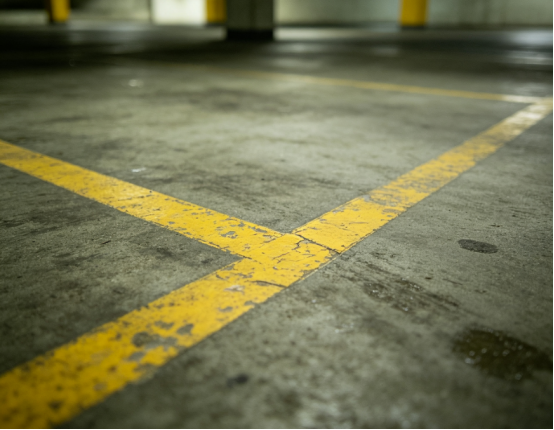
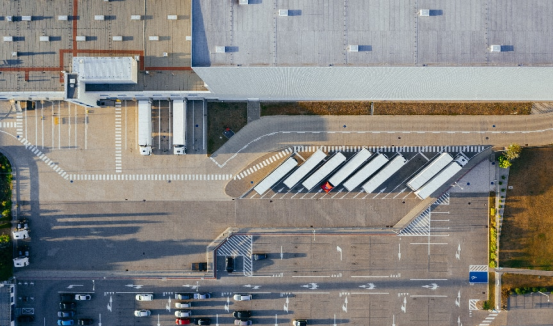
Every time it rains or water accumulates in low-lying areas of underground parking lots, ground markings seem to "disappear out of thin air", which easily leads to scratches and illegal parking of forklifts and private cars. Today we will explain the multiple reasons for the sharp drop in visibility of markings under water accumulation, and share marking solutions suitable for humid sites.
Four Core Reasons for Indistinct Markings in Standing Water
1. Water film changes the principle of optical reflection
In dry conditions, markings reflect light through the coating, creating a clear color contrast with dark pavements. Standing water forms a smooth mirror surface that refracts all vehicle lamp light and natural light upward instead of bouncing back to human eyes. The refractive index of water is higher than air, so most light passing through the water film scatters, drastically reducing the reflectivity of markings and making them nearly invisible at night. If the marking paint itself has insufficient color saturation with faint color contrast, it will blend completely into the pavement once covered by water.
2. Aging and damaged coatings amplify visual defects under water exposure
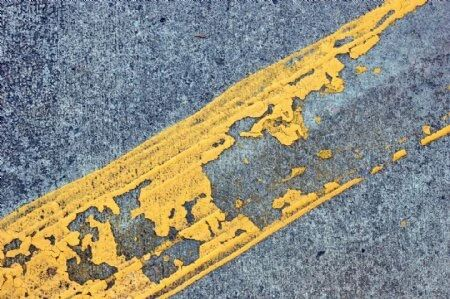
Long-term exposure to the open air and humid conditions continuously wears down road markings: surface pigments wear off and turn pale, greatly reducing color contrast with the ground. Cracks and pits form on markings, where standing water collects and breaks complete lines into scattered color patches. Low-quality paint has poor water resistance; after rain soaking, the paint film turns gray, swells with water, peels off, fades on sunny days and vanishes entirely on rainy days. Ordinary coatings feature weak adhesion, allowing water vapor to penetrate easily and cause delamination and peeling in a short time.
3. Oil, sludge and sediment fully cover the original color
Parking lots and factory floors accumulate tire oil, dust and silt all year round, which only slightly affect appearance when dry. Standing water floats dirt evenly over the marking surface to form a turbid covering layer that completely conceals the original color of the markings. Only paint with a dense, smooth film resists oil and silt adhesion, and stains can be washed away quickly by running water to keep markings clear.
4. Alternating wet and dry conditions accelerate structural damage to markings
Underground parking lots and low-lying factory areas experience large temperature swings day and night. Repeated soaking and evaporation of standing water subject marking coatings to continuous thermal expansion and contraction, expanding tiny cracks. Water vapor seeps into gaps between the coating and pavement, causing peeling and edge warping, and the damaged area keeps expanding. Ordinary coatings have loose films and poor weather resistance, aging twice as fast under repeated wet-dry cycles, and quickly suffer from fading and chalking.
Long-term Solutions for Sites Prone to Standing Water and Humidity
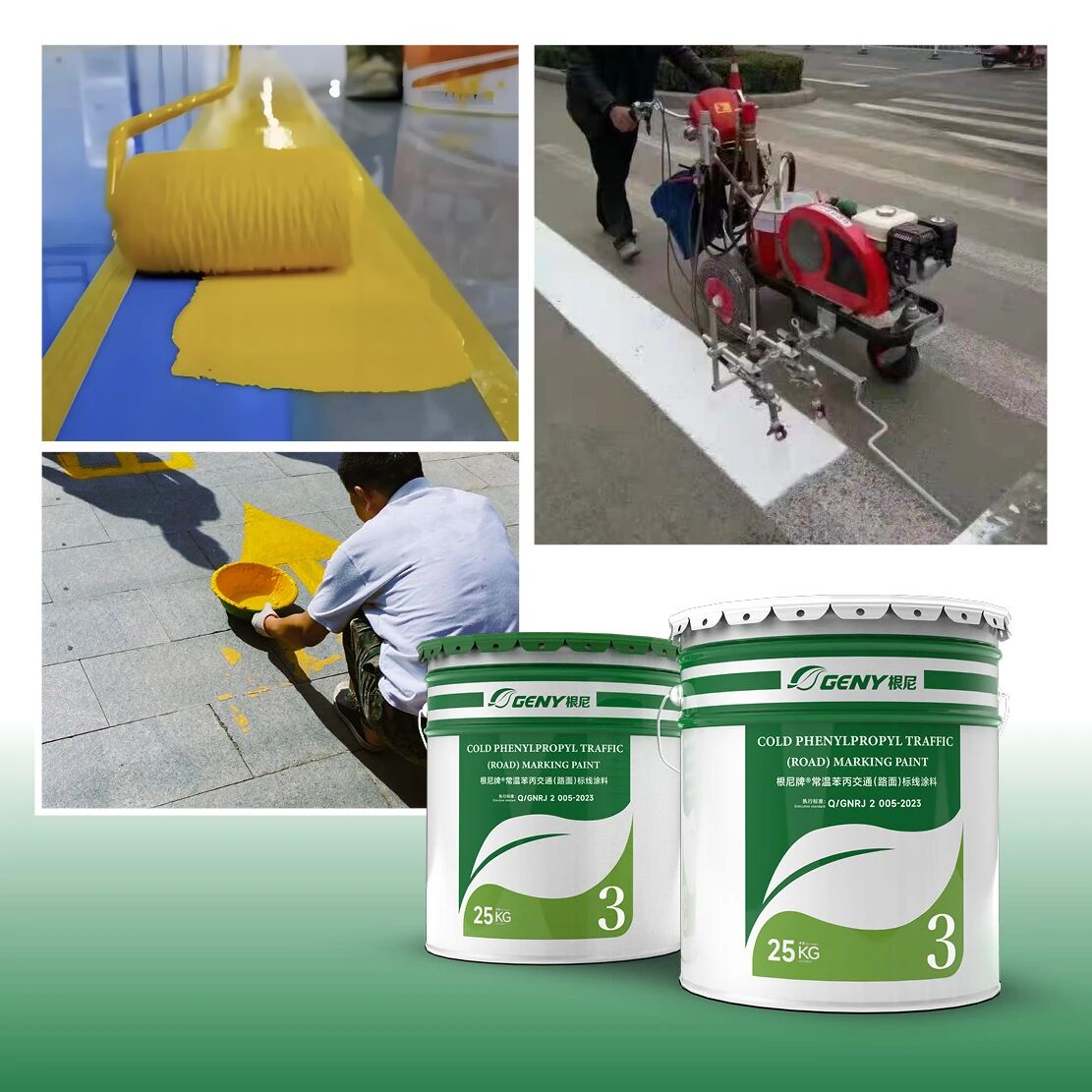
If you need large-area renovation of parking spaces and low-lying passages to keep markings visible even on rainy days with standing water, Geny acrylic cold road marking paint is the top choice to solve all marking failure problems caused by humid, waterlogged environments:
1. Dense, waterproof acrylic paint film
Made of high-quality styrene-acrylic resin, the formed paint film is dense and impermeable. It will not turn white or peel off after long-term rain immersion, blocks water vapor penetration, fundamentally delays cracking and delamination aging of markings, and resists erosion from alternating wet and dry conditions on site.
2. Highly saturated weather-resistant color paste
Vivid, rich white and yellow colors form a strong visual contrast with asphalt and cement pavements. Even covered by a thin layer of standing water, the outline of lines can be clearly distinguished, solving the problem of markings "disappearing" on rainy days.
3. Strong adhesion, stain resistance and wear resistance
It adheres firmly to asphalt and cement pavements and resists warping and peeling. The smooth paint surface repels oil and silt, and stains can be washed off by running water to maintain bright color for a long time. It withstands heavy vehicle rolling and weathering, resists chalking and fading under sunlight and rain, and greatly extends the service life of markings.
4. Easy construction and quick traffic opening
No dilution is required before use; it can be applied directly. It dries and hardens completely within 15 minutes, allowing vehicles to pass shortly after construction and shortening site closure time. The whole cold coating process involves no open flames, complying with safety standards for construction in enclosed underground parking lots and warehouses. It covers a larger construction area per kilogram of paint, delivering higher cost performance.
Summary of Popular Science
Markings "disappearing" on rainy days is not merely caused by water coverage, but a combined effect of optical refraction, coating aging, dirt coverage and moisture-induced structural damage. For humid, waterlogged sites, use waterproof and weather-resistant Geny acrylic cold marking paint, combined with regular inspection and repair, to keep markings intact and clear long-term, and avoid traffic safety hazards in factories and parking lots.