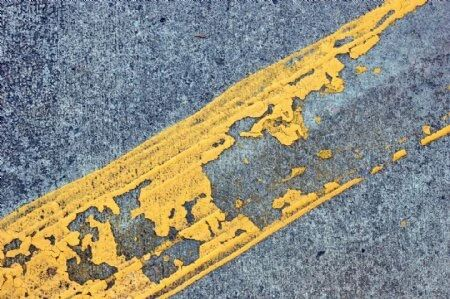
Many engineers have a misconception:
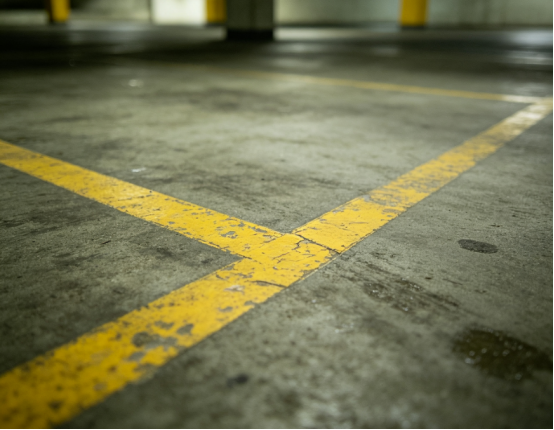
As long as the markings can still be seen, one feels that "they are still usable". However, when the markings become blurry, cracked and fall off, and are pointed out for rectification by the property owners, or even affect traffic safety, they will have to rush to redo the work, which is both costly and detrimental to the reputation.
In fact, whether the markings should be redrawn or not cannot be determined merely by the "it looks fine" criterion. Today, I will teach you several straightforward judgment criteria that are easy to understand. This will help you issue an early warning and make reasonable arrangements, avoiding both cost waste and delay in the acceptance process.
Viewing clarity: To what extent does it become blurry and does it require redrawing?
The core function of marking lines is to be "visible and clear". Once they become blurred, they lose their significance in guiding traffic.
1. The white/yellow marking lines have severely faded.
The color is grayish and dark. From a distance, it almost blends in with the road surface, and the night-time reflective effect is poor.
2. Edges are not clear.
The markings have become rough edges, blurred edges and broken lines. They are no longer straight and regular lines, and instead look messy and disorderly.
3. Insufficient coverage area .
The markings are incomplete and there are large areas of missing parts, which prevent the formation of complete directional, parking and speed-reducing signs.
⚠️ Attention
The national standard has specific requirements for the retroreflective luminance coefficient of road markings. Especially for main roads with heavy traffic and parking lot entrances and exits, if there is insufficient night-time reflection, it will pose a safety hazard. It is recommended to re-plot them in a timely manner.
Check the paint film condition: If any of these situations occur, re-painting is necessary.
The marking lines are not just "drawn on", but also "stuck firmly and without cracking". This is the key factor in determining whether the marking lines have become ineffective.
Peeling, falling off, hollowing out
1. There is a layering and lifting phenomenon between the paint film and the road surface. If you scratch it, it will come off easily.
2. Local areas have hollowing out and bubbles, and after being crushed by vehicles, large sections fall off.
3. The marking lines have extensive powder loss and chipping. They simply fall off when touched with your hand.
These circumstances indicate that the adhesion of the markings has failed. Continuing to use them will result in more and more deterioration. Not only will it affect the appearance, but it is also prone to being covered by the floating sand and oil stains on the road surface, completely losing its identification function.
Cracking, chipping, breaking
1. The surface of the marking lines shows mesh-like cracks and irregular fissures.
2. The paint film becomes brittle and cracks or breaks off after being crushed by the wheels.
3. In low-temperature or high-temperature environments, the markings contract / expand, resulting in cracking.
When the markings crack, rainwater and oil stains will seep through the cracks into the base layer, further damaging the adhesion and accelerating the peeling process. This problem can only be solved by re-painting.
Review functional requirements: In these scenarios, the label "Expired" affects the acceptance.
Apart from the appearance and condition, whether the markings should be redrawn also depends on whether their "functional attributes" still exist:
Parking lot / Parking space markings
The parking lines are unclear, which leads to improper parking, vehicles running off the lines, occupying the passageways, affecting traffic efficiency, and even causing scrapes and disputes.
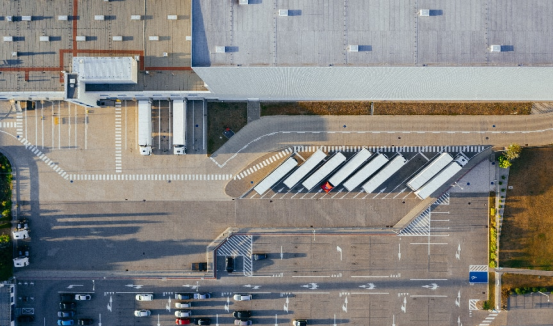
1. Road markings in the factory area / park area
The pedestrian crossing, the direction arrows, and the speed limit signs are unclear, failing to effectively guide the separation of pedestrians and vehicles. This poses safety risks and also hinders the standardized management of the factory area.
2. Municipal roads / Construction section marking lines
The stop lines, zebra crossings and guiding lines are not clear, which may lead to traffic accidents. These are safety issues that must be rectified.
Before the redrawing, these details must be paid attention to.
After the re-laying is completed, don't rush to apply the paint immediately. Follow these steps to ensure that the new markings are more durable:
1. Old line treatment: Old markings that are peeling, cracking or loosening must be thoroughly removed first, then ground smooth to prevent them from falling off along with the new paint once it is applied.
2. Road surface cleaning: Before construction, remove dust, oil stains and water accumulation from the road surface to ensure it is dry and clean, thereby enhancing the adhesion of the new paint.
3. Choose the Right Coating: Select the appropriate marking paint based on the road material and usage scenario. For example, for outdoor main roads, choose wear-resistant hot-melt paint; for indoor parking lots, choose environmentally friendly water-based paint to avoid the problem of "breaking down soon after use".
4. Avoid extreme weather conditions: High temperatures, intense sunlight, low temperatures with frost, and rainy and humid weather can all affect the drying and adhesion of the markings. Try to schedule the construction during sunny and suitable-temperature periods.